
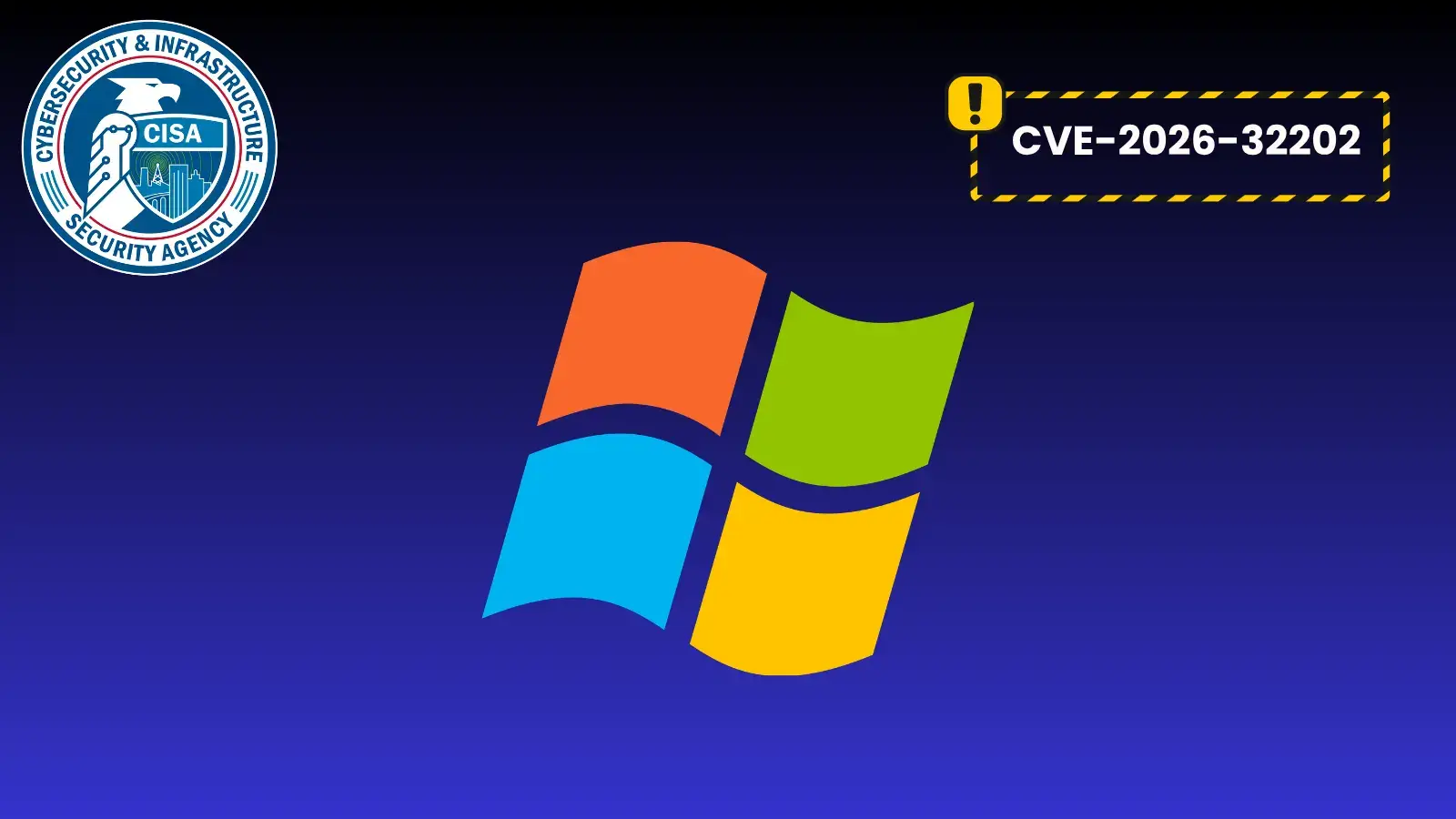
The Cybersecurity and Infrastructure Security Agency (CISA) has issued an urgent alert regarding a newly discovered zero-day vulnerability affecting Microsoft Windows.
On April 28, 2026, the agency officially added CVE-2026-32202 to its Known Exploited Vulnerabilities (KEV) catalog. This critical flaw involves a failure of a protection mechanism within the Microsoft Windows Shell, and active exploitation has been confirmed in the wild.
To assist with automated tracking, CISA makes the KEV catalog available in multiple accessible formats. Defenders can download the intelligence in CSV, JSON, or a printable view to integrate directly into their security information and event management systems.
Windows Shell Zero-Day Exploited
The vulnerability, tracked as CVE-2026-32202, targets the Microsoft Windows Shell interface. It is specifically categorized as a protection mechanism failure, mapped to the Common Weakness Enumeration (CWE)- 693.
This weakness occurs when a system fails to implement defensive measures intended to block unauthorized actions properly.
In this case, the failure allows an unauthorized attacker to perform spoofing attacks on the network successfully. Spoofing attacks generally allow malicious actors to disguise their communication as coming from a trusted internal source.
This deception can easily lead to unauthorized network access, data interception, and further compromise of the internal environment.
While CISA has confirmed that attackers are actively exploiting this vulnerability, the full scope of the malicious campaigns remains under investigation.
Currently, it is unknown whether ransomware operators have weaponized CVE-2026-32202 for their extortion attacks.
Because network spoofing often serves as a stepping stone for lateral movement and privilege escalation, the potential for severe operational impact remains extremely high for vulnerable networks.
To protect critical infrastructure and federal networks, CISA has mandated a strict remediation timeline for this zero-day flaw. Federal Civilian Executive Branch agencies must secure their vulnerable systems by May 12, 2026.
Private businesses and organizations worldwide are strongly encouraged to adopt this same deadline to prevent potential network breaches.
Administrators must implement the following security actions to neutralize the threat:
- Apply official mitigations and security updates provided by Microsoft immediately.
- Follow applicable Binding Operational Directive 22-01 guidance when securing connected cloud services.
- Discontinue the use of the affected product entirely if official vendor mitigations cannot be applied.
- Monitor network traffic logs for anomalous spoofing patterns or unauthorized access attempts.
Follow us on Google News, LinkedIn, and X to Get Instant Updates and Set GBH as a Preferred Source in Google.
