

SAP data is powerful, but it can be difficult to correlate with each other
Anyone who has worked with SAP data knows the challenge: table names like and column names like are technically precise but can be difficult to correlate with each other. Data engineers spend hours mapping these identifiers to business meaning, and that work often lives in spreadsheets, internal documentation, or tribal knowledge — far from the data itself.
With the Databricks and SAP partnership, we set out to change that.
Sync semantic metadata automatically
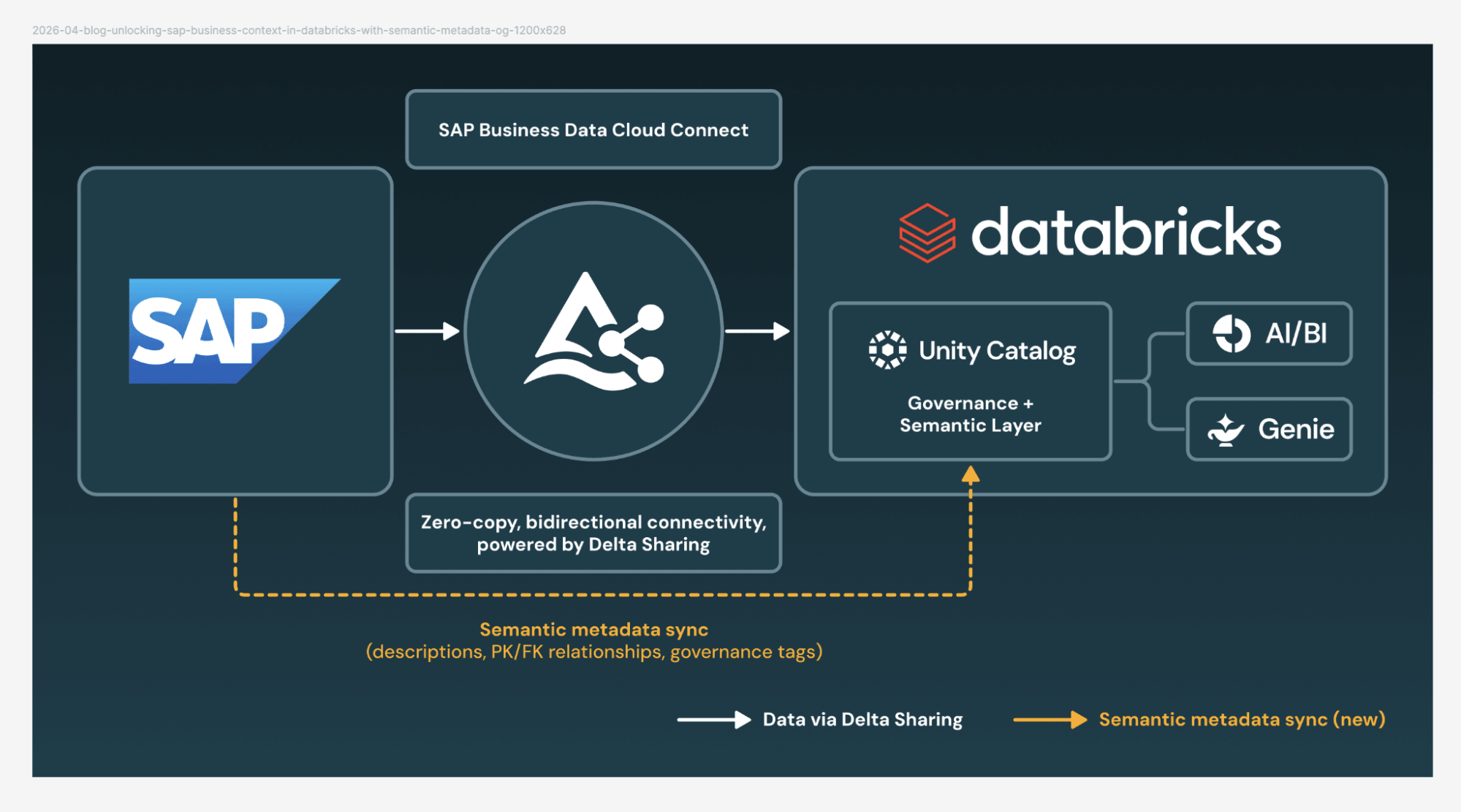
We are pleased to announce the General Availability of semantic metadata sync between SAP Business Data Cloud and Databricks Unity Catalog. For all mounted SAP BDC Delta Shares, semantic metadata is now automatically shared into Unity Catalog at the table level when a table is accessed, making SAP data more understandable and discoverable. Any changes made in SAP BDC are reflected in Unity Catalog – SAP BDC remains the single source of truth for semantic metadata. This means that the moment a data practitioner or AI agent encounters an SAP table in Databricks, they see business-friendly display names, descriptions, and context — not just raw SAP identifiers. No manual data dictionaries. No back-and-forth with SAP administrators.
This new capability builds on SAP Business Data Cloud Connect to Databricks (BDC Connect), which allows SAP teams to publish governed SAP data products into the Databricks Platform via Delta Sharing. By synchronizing semantic metadata and governance tags alongside those data products into Unity Catalog, Databricks users can more easily discover, combine, and operationalize SAP data products with other enterprise sources for analytics and AI, without having to recreate business context or governance in a separate system.
Why it matters for AI
The value goes beyond human readability. As organizations build AI agents and analytical applications on top of SAP data, rich semantic context is what separates a useful agent from a confused one. Without SAP’s embedded domain logic, AI outputs lack critical business context — reducing accuracy and relevance. Semantic metadata solves exactly this, grounding AI in the business meaning that SAP has encoded over decades of enterprise operations.
One of the most significant benefits of this metadata synchronization is its impact on AI-assisted data engineering. By bringing in column descriptions and table relationships like Primary and Foreign Keys, we provide the necessary context for the Databricks AI Assistant and AI/BI Genie to thrive.
Instead of an AI model guessing how a table like VBAK relates to VBAP, Unity Catalog provides the explicit semantic map. This allows users to ask natural language questions – like “What is the relationship between the tables SalesOrder and SalesOrderItem?” – and receive accurate, join-ready queries instantly, because the AI finally speaks the “language” of your SAP data.
Governance tags included
SAP BDC also syncs governance tags in the PersonalData namespace as system governed tags on tables in Unity Catalog — automatically applying data classification signals that teams need for compliance, access control, and responsible AI. No manual tagging required.
Learn more
Delta Sharing Connector for SAP:
https://learn.microsoft.com/en-us/azure/databricks/delta-sharing/sap-bdc/semantic-metadata
https://docs.databricks.com/aws/en/delta-sharing/sap-bdc/semantic-metadata
https://docs.databricks.com/gcp/en/delta-sharing/sap-bdc/semantic-metadata
SAP Databricks:
https://docs.databricks.com/sap/en/share-data#sap-bdc-semantic-metadata
Ready to streamline your workflow? Try out SAP semantic metadata in your Databricks environment today.
