

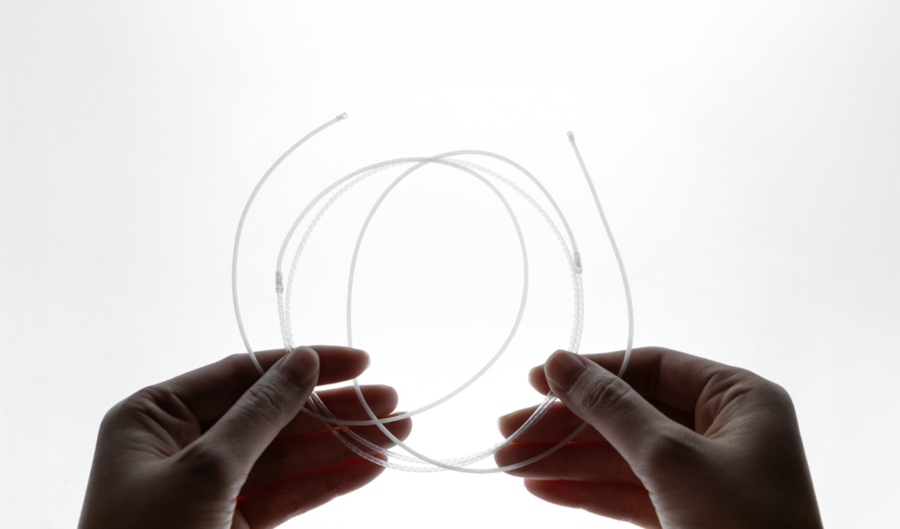
Researchers have developed new artificial muscle fibers that operate silently without motors or external pumps, potentially transforming robotics and assistive devices. The technology, known as electrofluidic fiber muscles, was detailed in a study published in Science Robotics by a team led by MIT Media Lab PhD candidate Ozgun Kilic Afsar and Vito Cacucciolo of Politecnico di Bari.
The electrofluidic fiber muscles combine McKibben actuators with miniaturized electrohydrodynamic (EHD) pumps, creating pressure within a sealed fluid compartment. The EHD pumps operate by injecting charge into a dielectric fluid, generating ions that move the liquid. Each pump weighs only a few grams and measures approximately the thickness of a toothpick. This setup features a fiber pump positioned between two McKibben actuators, allowing one to contract while the other relaxes, echoing human muscle movement.
Afsar stated, “We didn’t choose this configuration simply for the sake of biomimicry, but because we needed a way to store the fluid within the muscle design.” The closed circuit design eliminates the need for an external fluid reservoir, addressing a major limitation of fluid-driven soft robots that have primarily remained experimental.
Stay Ahead of the Curve!
Don’t miss out on the latest insights, trends, and analysis in the world of data, technology, and startups. Subscribe to our newsletter and get exclusive content delivered straight to your inbox.
Subscribe Now
The fibers can be arranged similarly to biological muscle tissue, enabling them to be dispersed throughout a structure rather than focused near joints. Demonstrations included a woven biceps-triceps pair that powered a 3D-printed robot arm and a lever arm capable of launching objects in just 100 milliseconds.
Herbert Shea from Ecole Polytechnique Federale de Lausanne praised the work, labeling it “a major advancement in fiber-format soft actuation.” He highlighted that the absence of moving parts in the pump contributes to silent operation, a significant benefit for prosthetic devices and assistive clothing.
The team anticipates various applications for the fibers, including exoskeletons designed to assist with lifting heavy loads and devices aimed at restoring dexterity. Cacucciolo remarked, “Wherever fluidic actuators are used, or where engineers want to replace external pumps with internal ones, these design principles could apply across a wide range of fluid-driven robotic systems.” The research received support from the European Research Council and the MIT Media Lab’s multi-sponsored consortium.
Featured image credit
