

If necessity is the mother of invention, the Diggers on the shores of Gallipoli in 1915 had it in spades.
As Australians and New Zealanders pause on April 25 to remember, reflect and pay tribute to the ANZACs and all who have served the two countries on our militaries, Startup Daily wants to share the stories of three extraordinary innovations that emerged during the eight month World War 1 campaign on Turkey’s Gallipoli peninsula.
This deadly campaign, which saw around 60,000 Australians in the AIF land on those Turkish shores in the Agean Sea, led to more than 8700 dead and 19,400 wounded – a casualty rate of nearly 50%.
The following comes courtesy of the Australian War Memorial and the remarkable 12-volume Official History of Australia in the War of 1914-1918 by historian Charles Bean – the driving force behind the establishment of the AWM.
Here are three incredible inventions that emerged during that period – plus a later one, developed at the start of WWII that changed the nature of warfare.
Get the best of Startup Daily straight to your inbox
Want to know the latest in startup news? Subscribe to our daily news and analysis coverage on what’s happening to ANZ startups, investors and the broader ecosystem. And best of all, it’s FREE!
By continuing, you agree to our Terms & Conditions and Privacy Policy.
The periscope rifle
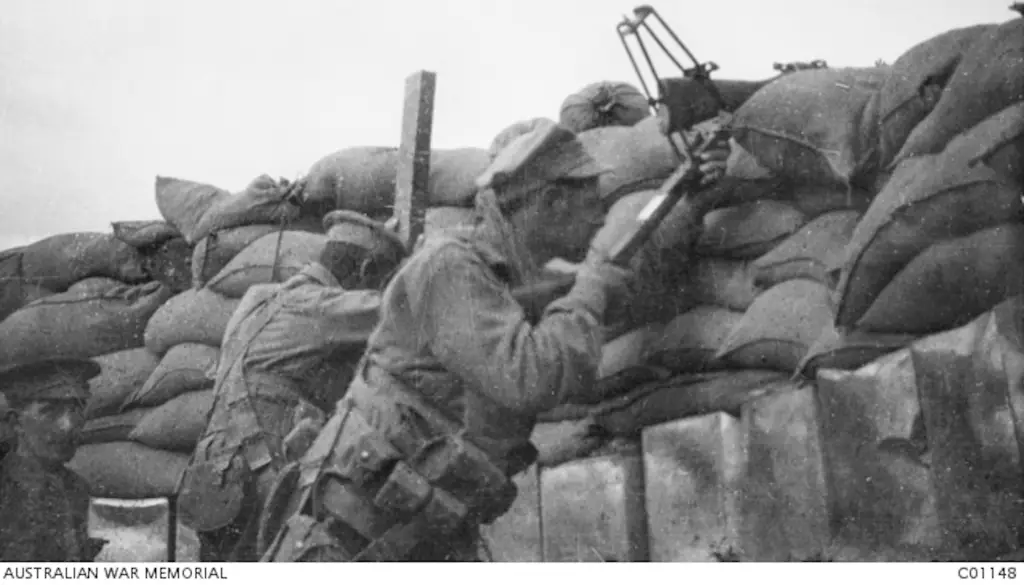
A British Admiralty photo, dated April-May 1915 of ANZACs at Gallipoli using a ‘sniperscope’ (the rifle) and periscope at Gallipoli in the area that would become Quinn’s Post. The Australian War Memorial identified the men as Sergeant Ernest William Crain; unidentified; 313 Trooper Arthur Snowdon Demaine; Lieutenant Joseph Burge (killed in action 7 August 1915) of the 2nd Light Horse Regiment. Image: AWM.
We all know the scene from films such as Peter Weir’s Gallipoli – the moment you emerge from the frontline trenches, a bullet from the enemy finds you.
At Quinn’s Post – named after Major Hugh Quinn, who was killed leading the charge against the enemy there – the Turkish trenches were less than 50 metres apart – the length of a swimming pool.
A month into the campaign Lance Corporal William Beech, a builder’s foreman in the 2nd Battalion, came up with the idea of a using two mirrors, mounted on a rifle as a periscope, enabling soldiers to see and shoot over the trench’s sandbagged parapet without exposing themselves to enemy fire.
The periscopes rifles went into production at a workshop on the beach at Anzac Cove – they’d made 300 periscopes for observation by the end of May – and played an important role on the front lines in keeping the Diggers safe, as well as deadly accurate with their gunfire.
The jam tin bomb
Two ANZACs, with the one on the right identified by the AWM as possibly Private Harry Edward Feutrill, 11th Batallion of Kalgoorlie, WA, an electrician; make bombs the old jam tins and other used containers filled with fragments of Turkish shells and enemy barbed wire which had been cut into small lengths. Feutrill rose to Lieutenant in 1918, and returned to Australia on 1 June 1919, having served with the 11th Battalion for his entire war service. Image: AWM
Gallipoli wasn’t a priority for British command and so the troops were under-resourced when it came to weaponry such as bombs, so they improvised by creating one of the first IEDs (improvised explosive device) from their rations – used jam tins packed with shrapnel and explosive
Barbed wire, nails and small pieces of shells were packed into the tin to create a rudimentary grenade.
Once again, the soldiers set up a factory in early May above ANZAC Beach in May and by the following month, it was producing more than 200 bombs daily. On report says that on August 7, 54 men worked a bomb makers for the battle at Lone Pine.
They could be thrown about 23-32m and the advice was do to it lying on your back from behind cover.
The drip rifle
A drip rifle set up at Gallipoli. Image: AWM
This was a piece of genius by Lance Corporal William Charles Scurry of the 7th Battalion, that enabled the safe evacuation of troops from Gallipoli in December 2015 by making the enemy think soldiers were still there firing at them.
80,000 men were evacuated with less than 10 casualties.
There were two types self-firing rifles used – the other had a string holding the trigger, while candle burnt through it, releasing the trigger to fire the gun.
The drip rifle used two kerosene tins, atop each other, with the higher one filled with water and the lower one attached to a string to pull the trigger. Before leaving, the ANZACs punched drip holes in the top tin. It leaked down to the bottom one until it was heavy enough to pull the trigger.
The sporadic gunshots were enough to convince the Turkish soldiers that the enemy remained unseen in their trenches long after they’d evacuated.
Scurry, later Captain Scurry, was mentioned in dispatches, awarded the Distinguished Conduct Medal, and promoted to sergeant for his role in the safe evacuation of the troops.
The Owen submachine gun
The Owen submachine gun. Image: AWM
While those inventions happened at Gallipoli, another by a 24-year-old Wollongong inventor would become a key weapon for Australia soldiers from WW11 to Korea and Vietnam 25 years later – the Owen submachine gun.
It became known as the “Digger’s darling” for its reliability during the New Guinea and Kokoda Track fighting in the rain and mud, and more than 50,000 were made. But like all founders ahead of their time, Owen faced his doubters and struggling to get his idea embraced, in part because he had no formal engineering or firearms training.
He started working on the idea for an compact automatic weapon in 1931, aged just 16. Its genius was its simplicity, with the bolt as the only working part to prevent jamming. It has a top-mounted, 33-round magazine, fed by gravity, with a “blowback action” mechanism.
The prototype used .22 calibre bullets with a thumb trigger and revolver magazine. When army officers at the Victoria Barracks in Sydney saw it in 1939, they were unimpressed. “That is an American gangsters’ gun; the army has no use for those,” an Australian Army colonel said.
Owen joined the 2nd Australian Imperial Force (AIF) as a private when war broke out and then luck changed things while he was on leave before deployment in September 1940.
The general manager of a steelworks, Lysaghts, in Port Kembla, Vincent Wardell, a neighbour, found it by accident after Owen had fired off a few rounds and left it out in a sugar bag.
He became an advocate of the weapon using contacts in the military and Owens was sent to Melbourne to work on it further. But the Australian Army remained resistant, believing it could rely on the British for weaponry
Wardell’s firm was encouraged by some to continue development, even as the Army’s senior ranks tried to stymie the project. They retooled the SMG in just three weeks submitting a new version in January 1941 with a traditional trigger, dual pistol grips, and a detachable top-mounted box magazine.
But the army wouldn’t give them bullets for testing. So two months later Wardell had developed another prototype using .45-calibre Automatic Colt Pistol (ACP) bullets – used in the Thompson submachine gun
The Army blocked ammunition supplies again. The Lysaghts boss went ballistic about the military’s stalling, but developed a 9mm version too.
After it outperformed the Army’s preference, the Sten SMG, which jammed multiple times in trials, an order for 2000 Owen guns was placed in October 1941. The 9mm version became the standard in 1942.
But Australia lacked manufacturing capacity and they could only produce 2,000 guns a month. US general Douglas MacArthur’s Southwest Pacific Area Command put it an order for 60,000, but it couldn’t be filled.
The Owen SMG could fire of 700 rounds a minute, 4.8kg loaded and had an effective range up to 200 metres
Owen, born just 20 days after the first ANZACs landed at Gallipoli, died in 1949, aged 34, due to alcohol abuse. He received only partial recognition and payment for his invention.
So they’re just some of the stories from 110 and 85 years ago. There have been more and startups now working to make the Australian Defence Force more effective at protecting us all.
To conclude, this author wants to acknowledge his great-grandfather, Private Charles Leaden of the 43rd Infantry Battalion, 7th and 8th Reinforcements, who saw action on the Western Front in France and Belgium during WWI; his great uncle, flying officer Thompson Neville Digby Boyd of the Royal Australian Air Force · No. 23 Operational Training Unit (RAF), killed when his bomber exploded mid-air in October 1941; and his grandfather, Warrant Officer Class 2 Ian “Bill” Boyd, of the 2/1st Medium Regiment, who served in the Middle East during WWII, and became Regimental Sergeant Major (RSM) of the School of Artillery at North Head (1963-68).
Lest we forget.
