

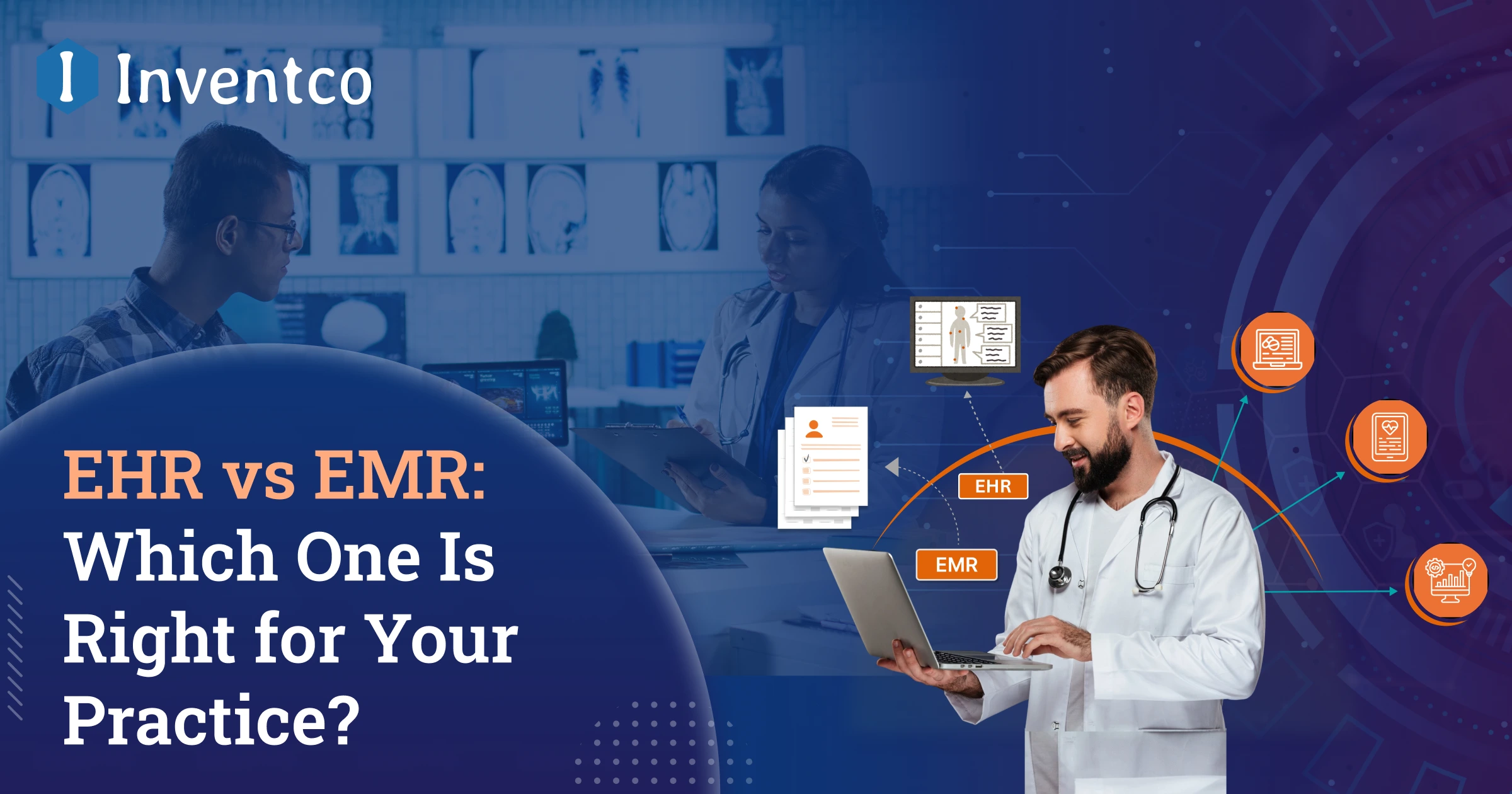
Digital health records have become the backbone of contemporary healthcare. According to the National Coordinator of Health Information Technology, 78% of office-based doctors and 96% of non-federal acute care hospitals have adopted certified electronic health record technology. EHR may lead to a decrease in clinical documentation time by up to 75 minutes/day. It is estimated that the global EHR market will increase to approximately $56.97 billion by 2034.
These figures demonstrate the rapid shift towards digital workflows in healthcare, replacing paper charts. However, there are many providers, clinic owners and administrators who are uncertain of the distinction between the EHR vs EMR. Being familiar with the difference is significant since the decision that you take will influence the coordination of care, compliance, reporting, engagement with patients, and long-term costs.
The meaning of EMR vs EHR in healthcare is important to consider when you evaluate a healthcare software in regard to a clinic, hospital, specialty practice, or any growing care network. Not only patient safety and billing will be affected by your choice, but long-term scalability and data security as well.
Important Takeaways
- EMR is an electronic format of a patient chart utilized primarily in a single practice.
- An EHR is a more comprehensive system that enables the sharing of data among care settings and providers.
- Interoperability and care continuity is the essence of EHR vs EMR difference.
- EMRs are usually easier and less expensive to implement for smaller practices.
- EHRs are better for growing organizations, coordinated care, and compliance-heavy environments.
- Workflow, budget, specialty, and future growth should be taken into consideration as a practical comparison of EHR vs EMR systems.
- The correct option will be based on your practice size, volume of patients, and model of care delivery.
What Is an EMR?
To understand EHR vs EMR definition, it helps to start with EMR.
EMR is a computerized version of a paper chart employed within one healthcare organization. It stores records of patients, diagnoses, medications, treatment records, allergies, laboratory reports, and clinical records. To put it simply, EMR is meant to optimize internal clinical processes and not facilitate general data sharing.
Core EMR Features
1. Digital Patient Charting
Enables providers to document patient history, symptoms, diagnoses and treatment plans electronically with every visit. This enhances accuracy of documentation and records are easy to update and retrieve quickly.
2. E-Prescribing
Enables clinicians to send out prescriptions to pharmacies without using hand written notes. It helps to reduce medication mistakes, speeds up prescriptions and improves prescription monitoring.
3. Lab and Imaging Integration
Link diagnostic reports, lab results, and imaging to the EMR dashboard. This makes clinicians more accessible to test data and it facilitates faster treatment decisions.
4. Appointment and Scheduling Tools
The use of appointment scheduling solutions helps the employees to keep a proper calendar, patient scheduling, follow-ups and reminders. It reduces the number of no-shows, increases workflow and helps to operate a better front-desk.
5. Billing Support
Coding, submission of claims, tracking payment and insurance documentation tools. This enhances efficiency in the revenue cycle and assists in minimizing claim errors or delays.
6. Clinical Templates
Offers templates of forms and notes that are specific to specialties to streamline and standardize clinical documentation. These templates are time-saving, enhance accuracy, and maintain standardized workflows of patient care.
When asking what is EMR vs EHR, EMR can be viewed as a practice-based digital charting tool.
What Is an EHR?
An Electronic Health Record (EHR) is a more detailed electronic health system that establishes a longitudinal patient history across various providers, facilities, and care episodes. In contrast to EMRs, EHRs are interoperable. They facilitate the exchange of information among hospitals, experts, laboratories, pharmacies and in a few instances even the patients themselves.
Core EHR Features
1. Cross-Provider Data Sharing
Enables secure exchange of patient data among hospitals, specialists, labs and pharmacies. There is a more comprehensive medical history for the providers, reducing unnecessary tests and treatment delays.
2. Patient Portals
Makes patient records, test results, appointments and prescriptions accessible online. Easy access will improve the interaction and make communication with the providers easier.
3. Clinical Decision Support
The existing EHRs are being modernised with AI-powered analytics and decision support systems, in line with the existing trends of AI in healthcare. They offer evidence-based recommendations and reminders and real-time alerts in the course of consultations.
4. Compliance and Reporting
Keeps audit trails, quality measures, and regulatory records within a single system. Formatted reporting eases compliance checks and enhances better practices in data protection.
5. Care Coordination Workflows
Supports referrals, discharge planning, follow-ups and inter-team communication. Fewer handoffs lead to less time wastage and enhanced patient care experience.
When you are interested in long-term care continuity, EHRs can be more valuable.
EHR vs EMR: Differences Explained
A clear EMR vs EHR comparison helps practices avoid overbuying or underinvesting.
Feature
EMR
EHR
Scope
Single practice or provider
Multiple providers and settings
Data sharing
Limited
High interoperability
Patient access
Usually limited
Often includes portal access
Care coordination
Basic
Advanced
Compliance support
Moderate
Strong
Reporting
Practice-focused
System-wide analytics
Implementation complexity
Lower
Higher
Scalability
Moderate
High
This table summarizes the core EHR vs EMR difference that healthcare leaders should evaluate.
Pros and Cons for Healthcare Providers
This breakdown gives a clear view of EHR vs EMR pros and cons.
EMR Pros
1. Lower Upfront Cost
EMR systems usually cost less to purchase and implement than EHR platforms. This renders them a viable option when it comes to cost-effective practices.
2. Simpler Implementation
EMRs are simpler to install since they serve in one practice. Employees are able to learn the system at a faster rate with minimal disruption.
3. Improved Internal Efficiency
EMRs enhance the process of charting, prescriptions, and appointments within a single location. This can minimize paper work and accelerate daily operations.
4. Better Record Accuracy
Electronic documentation minimizes writing mistakes and lost documents. With the increasing AI benefits for healthcare providers and the operational gains EHR platforms can deliver, many providers are realizing tangible benefits.
EMR Cons
1. Limited Interoperability
EMRs primarily contain information used in a single practice. Exchange of records with external providers may not be easy.
2. Restricted Care Coordination
Communication between patients visiting various specialists can be disjointed. This may delay referrals, follow-ups and treatment decisions.
3. Scalability Limitations
EMRs do not necessarily support complex workflows as a practice expands. Additional locations or services may involve expensive upgrades.
4. Compliance Challenges
Traditional EMRs are not going to conform to changing reporting standards. This may cause problems with regulations and reimbursement.
EHR Pros
1. Improved Care Coordination
EHRs enable providers to share patient records with providers in different locations. This helps in faster referrals and informed treatment.
2. Better Patient Engagement
Most EHRs have portals of appointments, reports, and messages. Patients remain more engaged in their care process.
3. Stronger Compliance Support
EHR systems are frequently provided with integrated reporting and security. These tools assist in fulfilling regulatory and documentation needs.
4. Long-Term Scalability
EHRs have the capability to serve expanding teams, sites, and services. They are more compatible with expansion in the future.
EHR Cons
1. Higher Initial Investment
EHR systems tend to be more expensive to install and license. The initial cost can be a challenge for smaller practices.
2. Complex Implementation
The implementation of EHR is frequently more time-consuming and strategized. Workflow modifications have a short-term impact on the staff productivity.
3. Training Requirements
Employees should be adequately onboarded to utilize advanced EHR features. Training can be consuming in terms of resources and time.
4. Integration Challenges
It can be challenging to integrate EHRs with labs, billing, or legacy systems. Full system benefits may be slowed by technical problems.
When to Use EHR vs EMR: Choosing the Right System?
Choosing between EHR vs EMR systems depends on several factors:
Choose an EMR if:
- You run a small independent practice
- You require quicker execution
- Your referrals are limited
- Budget is a key concern
- Your process is fairly straightforward
Choose an EHR if:
- You work at multiple locations
- You coordinate with specialists and hospitals
- You require more robust reporting and compliance software
- You plan to scale your practice
- One of the priorities is patient experience
Questions to Ask Before Choosing
- How frequently do you share patient records outside?
- What is your budget for setup and support?
- Are you required to have patient portal features?
- What is the complexity of your billing workflow?
- Will you increase your practice within 2-5 years?
This renders the EHR vs EMR examples discussion particularly significant in considering the real world requirements. When your practice requires a scaled out digital ecosystem, a custom healthcare software development can streamline the implementation process.
EHR vs EMR Cost Comparison
Cost is one of the biggest factors in the ehr vs emr cost comparison process.
Cost Factor
EMR
EHR
Initial setup
Low to moderate
Moderate to high
Monthly subscription
Lower
Higher
Training costs
Lower
Higher
Integration costs
Limited
Moderate to high
Maintenance
Moderate
Moderate to high
ROI timeline
Faster for small clinics
Higher long-term value
Typical Cost Considerations
EMR Costs
- Lower implementation fees
- Less infrastructure needed
- Lower customization expense
EHR Costs
- Data migration costs
- Integration with labs, billing, and pharmacies
- Security and compliance investments
- Ongoing support and optimization
EHR and EMR Integration: Can You Use Both?
Yes, both EMR and EHR systems can be used together by healthcare providers particularly when making digital transitions. A lot of practices begin with an EMR to maintain an internal record and eventually adopt an EHR to facilitate a wider sharing of data. This strategy assists to uphold continuity and increase capabilities.
Integration is likely to take place through APIs, middleware, or health information exchange platforms. These tools allow transfer of the patient records, prescriptions, lab reports and treatment histories across systems without risks. This means that without repetition of work, providers are able to have more comprehensive information.
The combination of both systems can minimize the disruptive effect, enhance the efficiency of a working process, and facilitate gradual modernization. But integration needs planning, staff training and compliance checks. In the case of growing practices, a linked arrangement can be a viable move towards complete interoperability and more coordinated patient care.
Conclusion
The EHR vs EMR debate does not concern which system is universally superior. It is what fits in with the workflow, growth plans, and patient care goals of your practice.
EMRs are ideal for smaller practices that need efficient internal recordkeeping. EHRs involve more connected care, scalable, and long-term digital transformation.
When comparing EMR vs EHR in healthcare, consider interoperability, implementation support, compliance requirements, and future expansion. The correct system needs to improve the clinical and operational effectiveness.
FAQs
Q1. What is the primary difference between EMR and EHR?
Ans. The biggest difference is that EMRs are used in one practice as compared to EHRs which are aimed at sharing information between providers.
Q2. Is EHR better than EMR?
Ans. Not always. EHR is more coordinated care and expansion, whereas EMR can be more feasible in smaller clinics.
Q3. Is an EHR compatible with a small clinic?
Ans. Yes. Smaller providers have been able to adopt cloud-based EHRs with ease.
Q4. Does EMR cost less than EHR?
Ans. In most cases, yes. EMRs are also less expensive to set up and maintain.
Q5. What is the confusion between EMR and EHR?
Ans. Due to the interchangeability between the terms used by vendors. But, the actual EHR vs EMR systems difference is in interoperability and scope.
Q6. How do I decide which system my practice needs?
Ans. Evaluate your patient flow, referral requirements, compliance requirements and long-term business objectives and then pick a platform.
Jitendra Jain
He is the CEO and Co-founder of Inventco, driving innovation in advanced computing and digital transformation. With deep expertise in modern IT ecosystems, he leads scalable, secure, future-ready solutions. His strategic leadership helps businesses accelerate growth, adopt innovation, and achieve success. You can connect with him on LinkedIn to follow his technology insights.
