

You can watch a replay of Glover’s message in the video embedded below.
]]>
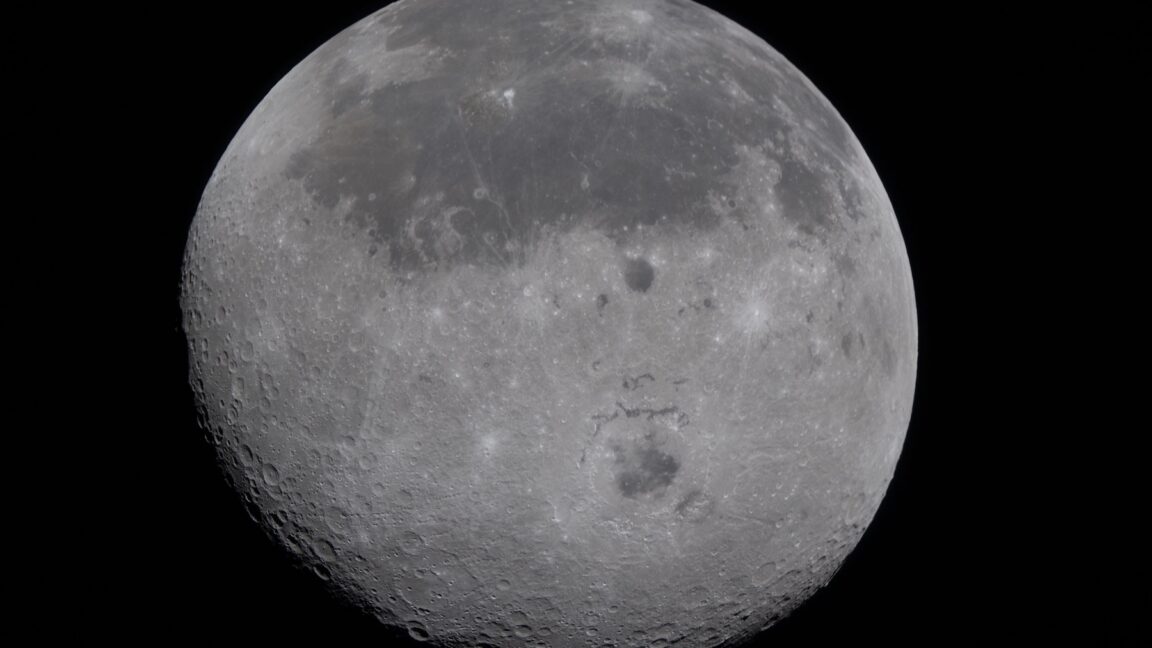
Out of view, Artemis II soared to the apogee, or farthest point, in its flight path, and Earth’s gravity began pulling the Orion spacecraft back home. The mission is tracking along a free return trajectory, meaning the gravitational influences of the Earth and the Moon are steering the capsule toward atmospheric reentry without needing any major rocket burns. A few more course correction maneuvers are planned in the coming days to fine-tune the trajectory.
The crew’s encounter with the Moon concluded with a long-distance call from President Donald Trump on Monday night.
The Trump administration, despite proposing cuts to NASA’s budget, is pushing the agency to land humans on the Moon by the end of 2028, when Trump’s term in the White House comes to a close and before China’s lunar program can deliver its own crew to the surface.
The timeline is aggressive, and may not be achievable, but NASA has more Artemis missions in the pipeline. After a recent revamp of the Artemis program, NASA now plans to launch the Artemis III mission as soon as next year on a flight in low-Earth orbit to dock with at least one of the two human-rated lunar landers under development by SpaceX and Blue Origin. Artemis IV will follow with a lunar landing attempt, assuming everything goes as planned.
Canadian astronaut Jeremy Hansen, NASA mission specialist Christina Koch, commander Reid Wiseman, and pilot Victor Glover after arriving at Kennedy Space Center, Florida, for Artemis II launch preparations.
Credit:
NASA/Jim Ross
Canadian astronaut Jeremy Hansen, NASA mission specialist Christina Koch, commander Reid Wiseman, and pilot Victor Glover after arriving at Kennedy Space Center, Florida, for Artemis II launch preparations.
Credit:
NASA/Jim Ross
The longer-term strategy calls for additional crew and robotic landers to deliver equipment to build a base near the Moon’s south pole, somewhat comparable to the international research facilities in Antarctica.
Koch, a spacecraft engineer and Antarctic explorer before joining NASA’s astronaut corps, told reporters before the launch of Artemis II that she hoped this mission would be “the start of an era where everyone, every person on Earth, can look at the Moon and think of it as also a destination.”
She echoed those thoughts in remarks from the Moon on Monday.
“The truth is the Moon really is its own unique body in the Universe,” Koch said. “It’s not just a poster in the sky that goes by. It is a real place, and when we have that perspective and we compare it to our home on the Earth, it just reminds us how much we have in common.”
