

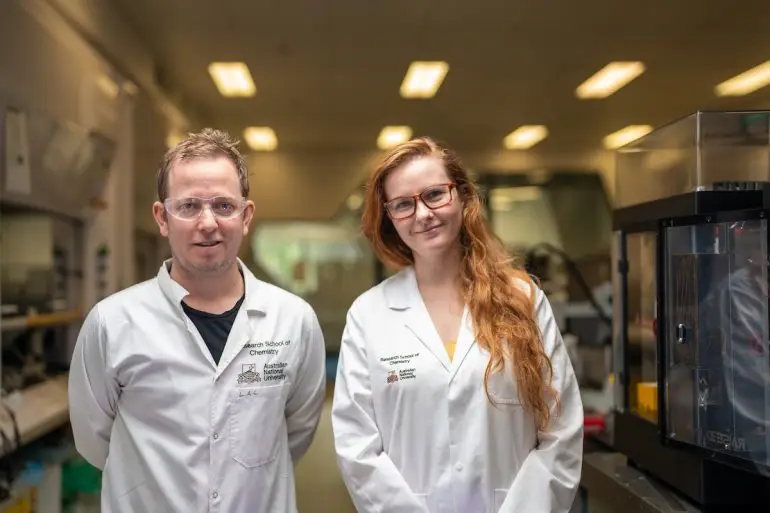
Australia’s AI data centre push could be bolstered by computer chip maker Syenta, which has raised $36 million (US$26m) in a Series A.
The round was led by Silicon Valley VC Playground Global and the National Reconstruction Fund, which chipped in $10.1 million. Existing investors Investible, Salus Ventures, Jelix Ventures and Wollemi Capital once again backed the six-year-old ANU spin out, now based in Sydney.
Playground Global general partner Pat Gelsinger, a former Intel CEO, will join the board
Syenta previously raised $2.2 million in late 2022, and then an $8.8 million pre-Series A in August last year. Other investors include Blackbird Jelix, Brindabella Capital, CIA-backed In-Q-Tel, SGInnovate and OIF.
The six-year-old, which began life focused on developing multi-material 3D printers, is now developing Localized Electrochemical Manufacturing (LEM) — a lithography-free process that enables scalable, high-density interconnects for advanced chip packaging – and hopes to begin semiconductor production in 2027.
The funding is for the commercialisation of the technology for high-volume production and expanding into the United States from a base in Arizona.
Get the best of Startup Daily straight to your inbox
Want to know the latest in startup news? Subscribe to our daily news and analysis coverage on what’s happening to ANZ startups, investors and the broader ecosystem. And best of all, it’s FREE!
By continuing, you agree to our Terms & Conditions and Privacy Policy.
Faster chip making
CEO and cofounder Dr Jekaterina Viktorova said early results from the LEM production delivered improvements in bandwidth and manufacturing efficiency, resulting in 40% fewer process steps, without the need to redesign of existing manufacturing infrastructure.
“Today’s advanced packaging approaches have real limits on interconnect density, which constrain the bandwidth between chips,” she said.
“We’re enabling finer-pitch connections within existing manufacturing infrastructure, allowing systems to move more data more efficiently and at a lower cost without requiring entirely new fabrication approaches.”
Gelsinger said that AI’s next scaling challenge isn’t just compute, it’s how chips connect.
“What’s compelling about Syenta is that the company is tackling a key constraint in advanced packaging and contributing to the expansion of a more resilient global semiconductor ecosystem,” he said.
“This is a new way of building high-performance systems at unprecedented scale and power, particularly as AI workloads continue to grow.”
While Nvidia has been one of the companies to benefit from the AI boom, the global semiconductor industry is exepected to more than double in value over the next four years to $US1.6 trillion by 2030 because of demand for AI applications and data centres.
