

Allow me the indulgence of riffing on something I read this week, that wasn’t all about politics: a New York Times column by Colson Whitehead, on AI.
Specifically, on why artists should not use it. There’s a free link here, if you have time.
The column is, by turns, both witty and annoying. A bundle of straw man arguments—“If you use it (AI) for art, you’re a freaking hack”—and some enjoyably high octane metaphorical jujitsu, such as this reflection on the dire environmental hazards of data centres
“…really makes those midnight chats with the love bot sort of bittersweet to know that the orgasms are measured in metric tons of melted glacier.”
Chef’s kiss, Colson, as ChatGPT would fo’ sho’ respond.
The core of his argument comes right at the end of the piece, where he insists he’s not defending humanity because we are, as he rightfully points out, the worst.
Rather, he’s simply extolling the virtues of doing the fucking work. (He says “the freaking work,” but that’s because it’s The New York Times, not Substack, so he doesn’t have the freedom to be his legitimate self).
Get the best of Startup Daily straight to your inbox
Want to know the latest in startup news? Subscribe to our daily news and analysis coverage on what’s happening to ANZ startups, investors and the broader ecosystem. And best of all, it’s FREE!
By continuing, you agree to our Terms & Conditions and Privacy Policy.
I’ll let him speak for himself, though.
“Read the book, not the summary.
Write the piece, not the prompt.
Suffer like the artist you are. It ain’t easy, but if it were easy, it wouldn’t be worth doing.”
This, I think, is the theory of the case I was hoping for from Whitehead. Unlike a lot of my friends in the writing biz, I’m not a bomb-throwing anti-AI jihadi.
My best guess is that, like gunpowder and the internal combustion engine, AI is a mixed blessing and a nuanced curse. As a guy who’s gone under the knife half a dozen times for melanoma excisions, I’ve got a little tooty horn here I blow every time I see a new story about how much better AI is than humans at detecting anomalies in medical scans.
As a writer whose entire backlist was stolen by tech-lord robber barons to train their plagiarism bots, I’m suing all of those motherfuckers until they are dead, dead, dead. So, you know, nuance.
Which I’m not entirely sure I share with Mr. Whitehead on this matter, but man, those last few lines really found me where I live. Because while Colson Whitehead is a noted artist of appreciable genius—a two-time Pulitzer Prize winner—and I merely write books that improve with altitude and/or proximity to the beach, we are, both of us, lovers of a good zombie story. Whitehead’s Zone One, an ambitious blending of genre and literary fiction set in an America ravaged by the undead, was shortlisted for the prestigious Hurston/Wright Legacy Award.
And me? Well, this week I cranked out my third contribution to John Ringo’s best-selling zombie-apocalypse narrative world, Black Tide Rising, and it was fucking awesome, with all the shooting and the biting. And my story had mad fucking bitey undead monkeys, which Whitehead’s didn’t, so, you know, Pulitzer Prizes don’t mean everything.
We are not so very different, Colson and I.
That’s why his throwaway about suffering for your art kind of reached me. I get the suffering artist meme, but I’m not sure most people do, most people who aren’t practising artists, anyway. Mostly, if you ask a punter to think of an artist suffering for their art—be it writing, painting, sculpting, whatever—they are gonna Rorschach up a vague image of some wretched hippie in a garret, eating spoonfuls of off-brand dog food and sleeping on scavenged bubble wrap.
The suffering is material because we all know the world does not recognise artistic genius. Just look at those two Pulitzers I didn’t win.
But that’s not what Colson means. The suffering he lauds is simply the pain of creation and improvement. I know it well, and I’m here to tell you: it fucking sucks.
This thing for my latest Ringo piece took me half a day…
First things first, but. She put six rounds into the two biters left behind and reloaded on the run, Bachelard easily keeping pace with her. They came in from the south, keeping to the shadow line of the scattered buildings, protecting their flanks from ambush and staying out of sight of the zombie herders up ahead. The streets weren’t empty. In the first two hundred metres, they passed four bodies, all of them infected, two of them ‘changed’ like the biters they’d cut through on the way to Orly Airport back in Paris.
They were grossly misshapen. Beneath ropy, livid scar tissue, new growths had budded in grotesque abundance, weirdly jointed arms jutting from nested ribs, clusters of legs thrusting out from the hips at impossible angles, as though the plague had remade them into crude mockeries of giant humanoid insects. It was horrific, but Caitlin noted with approval evidence of heavy weapons damage. So the villagers had fought back, and effectively.
Yeah, I know. It’s not Nobel Prize material, but maybe a Pulitzer in a quiet year? I dunno. Many people are saying.
Anyway, the reason I reproduce it here is to prove I’m not a newbie at describing zombie hordes. My previous two zombie stories for Ringo’s anthologies both had quite a few zombies in them. I’ve also written time-travelling First Fleet zombies.
And space marines vs space zombies in my Cruel Stars novels.
They moved carefully through the mounds of torn dead flesh, but every step of the massive armoured suits liberated some new chunk, or severed limb, or disturbed and drifting carrion cloud. Lucinda swept her arc. Ignored the loathsome and macabre tailings of the war crime which had been done here. Blood splatters painted the walls like the blazoned pennants of some demon army. The armoured suits were the aberration. Perverse in their clean lines and functional movement. The heinous dead had dominion now. She and the living were intruders.
The shivers that ran up and down her limbs threatened to morph into deep body spasms of revulsion. She occluded her faceplate, cutting off her vision of the passageway, relying instead on lidar sweeps from the suit’s external sensor nodes that rendered the long arc of the concourse in the simplest form, as a ray-traced outline, with dense clumps of organic matter represented by purely figurative geometries, emptied of spite and meaning.
So, long story short, this was not my first undead rodeo. And as I was staring at my screen, knowing I had to come up with a new and exciting way to describe something I’d already described many, many times before, I just wasn’t feeling it.
I was not feeling it so fucking hard that, as the hours piled up, I experienced a sort of discomfort which was not quite writer’s block, but which felt nearly as miserable as it did familiar. I was suffering for this bullshit.
That’s what Colson Whitehead meant. And that, I think, for writers and artists at least, is the real menace and scourge of AI. Not the plagiarism, not the raging torrent of slop, not even all the melted glaciers from the lonely late-night sex-bot action. It’s the end of suffering.
I can only speak for writers—the other arts will have to make their own cases—but for writers, as much as we hate writing, we do love having written, to steal from Dorothy Parker. We especially think fondly of the writing when it was hard. I dunno why that passage this week was so tough to get down, but it was.
In the end, I had to draft it by hand, but having done that (rather than just tossing the problem to an AI, which probably could have solved it for me, or at least got me unblocked), I found that after half an hour or so of scratching away at my notebook, I’d fallen into the flow.
That flow state you’ve heard about, or possibly even experienced yourself—that weird, abstracted place we go when we’re doing something right at the edge of our abilities—that is the reward you get even when you don’t get both Pulitzers, or the big book deal, or the massive royalty payment.
That is the reward AI takes from you. Sure, it makes things easier, it really fucking does. But easier is not always better.
Writing is not just a skill. I think of it as a very human strength. (Reading is too, for what that’s worth.)
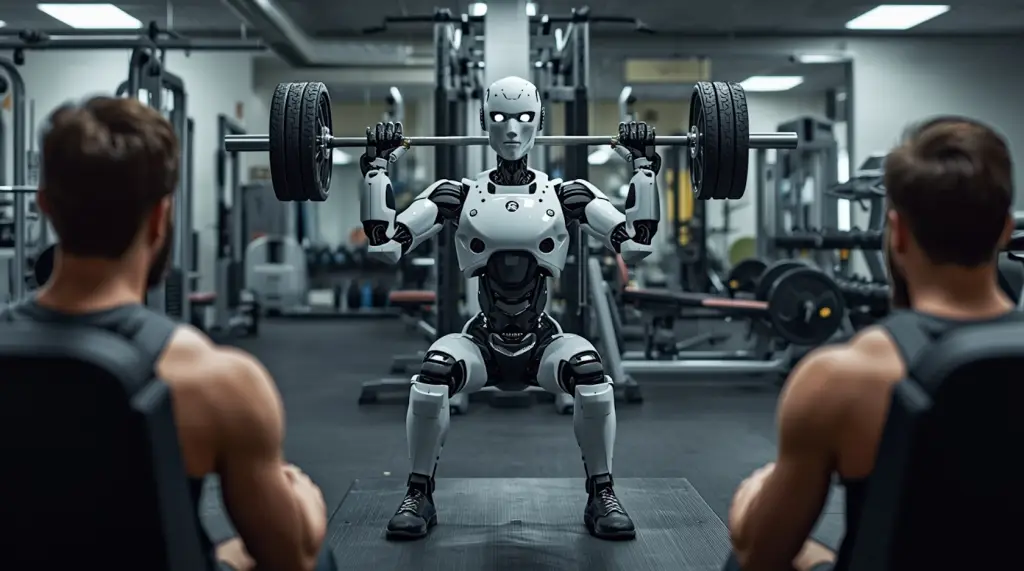
And like physical strength, it has to be trained constantly. You gotta get your reps in, even if and when you’ve done them countless times before. Because when you stop pushing against the weight and difficulty of your writing, your drawing, whatever, those muscles atrophy and your strength fades.
I worry about the baby authors coming after me, whether they’re students or would-be writers or whatever. I worry that, having grown up with AI, they haven’t had to really push the bar super hard just to get it an inch off their chest. They haven’t built those muscles, and they won’t get the opportunity to do so if AI consumes everything.
On the other hand, I was a tech writer for years, and you can trust my professional opinion when I tell you, AI writing is kinda crap, and probably always will be. That’s a good thing!
It’s why I don’t get upset the same way lots of my friends and colleagues do. I just don’t think this thing is a threat to writers in the way they imagine. Yes, Amazon is filling up with slop, but Amazon has always been full of slop.
No. AI is a threat in a different way.
By removing all difficulty from the act of creation, it removes the effort required of young writers to learn how to create in the first place.
