

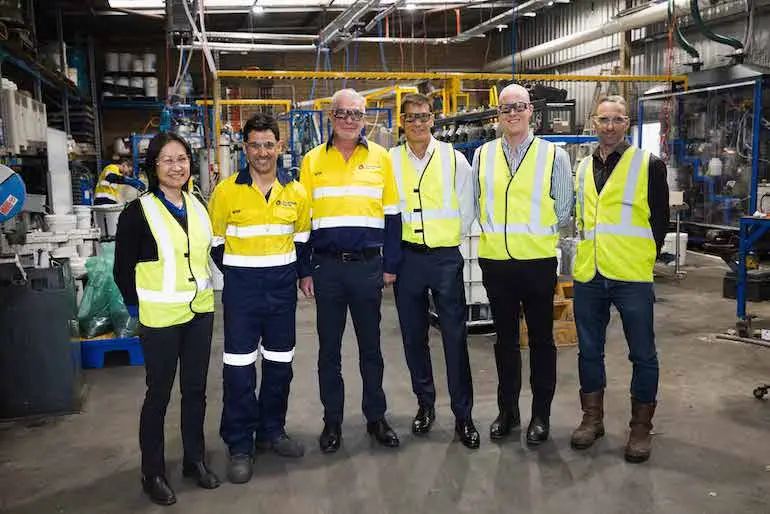
Lithium-ion battery recycling technology startup Renewable Metals has raised $12 million in a Series A.
The round was led by existing investor the Clean Energy Finance Corporation, supported by the Neglected Climate Opportunities, European Metal Recycling (the UK’s largest end-of-life recycler), and impact VC Investible, as well as Climate Tech Partners.
Renewable Metals previously raised $16.1 million in a Seed round in two tranches – $8.1m in September 2024 less than 12 months after previously raising $8m.
The new capital will support a demonstration plant in Kewdale, Western Australia that’s about to come online , and recycle up to 2,000 tonnes of batteries (about 4000 EVs) annually. Another commercial plant is also on the drawing board for the Hunter region, north of Sydney.
Renewable Metals has developed a patented hydro-metallurgical process that can achieve over 95% recovery of lithium, cobalt, nickel, copper and manganese from li-ion batteries. It also works for Lithium Iron Phosphate (LFP) batteries. The process, in modular plants, has the ability to extract critical minerals in the same process line, combined at up to half the cost of existing processes.
Sovereign capability
Chairman Peter Beaven said China is global leader in li-ion battery recycling processor, with Western markets reliant on exporting materials offshore for processing.
Get the best of Startup Daily straight to your inbox
Want to know the latest in startup news? Subscribe to our daily news and analysis coverage on what’s happening to ANZ startups, investors and the broader ecosystem. And best of all, it’s FREE!
By continuing, you agree to our Terms & Conditions and Privacy Policy.
“Renewable Metals is building a platform that can compete with leading Chinese recyclers at scale, while enabling full onshore recovery of critical minerals in Western cost environments and beyond,” he said.
“That’s critical to building resilient supply chains and reducing dependence on offshore processing as demand accelerates.”
Climate Tech Partners cofounder Patrick Sieb said battery recycling is becoming a critical geopolitical capability.
“It is expected that the EU, US and Australian governments will introduce recycled content mandates and restrict the export of battery waste. Renewable Metals’ technology and modular commercial plants can scale into these markets and secure critical minerals supply domestically,” he said.
“There is a clear global race to develop this technology as supply chains become reliant on critical minerals.
“A cost and environmentally effective recycling solution is welcomed as a number of our corporate partners already need to deal with defective or damaged batteries and are actively planning for end-of-life batteries in their portfolios.”
